Department of Electrical and Computer Engineering
Contact
Mailing Address
Cleveland State University, Department of Electrical and Computer Engineering
2121 Euclid Ave., FH 332
Cleveland, Ohio 44115-2214
Campus Location
Fenn Hall Room 332
1960 East 24th Street
Phone: 216.687.2589
Fax: 216.687.5405
ece@csuohio.edu
Intelligent Wireless Communications and Networking Research
Cleveland State University (CSU) offers a high-quality research ecosystem dedicated to advancing communications, information theory, signal processing, and networking across diverse and challenging environments. CSU researchers partner and collaborate with federal, state, and private partners to develop and deliver innovative engineering solutions in terrestrial and non-terrestrial environments.
Featured Laboratory
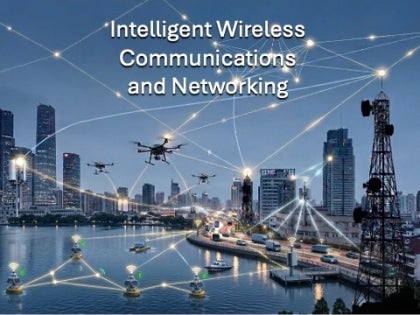
The Intelligent Communications and Autonomous Systems Laboratory (ICAS Lab), directed by Dr. Mehdi Rahmati, conducts interdisciplinary research addressing fundamental challenges in wireless connectivity and autonomous systems. The lab specializes in the design and analysis of intelligent algorithms, architectures, and protocols aimed at enhancing the performance, reliability, and efficiency of technologies in diverse and challenging environments. Current projects span a broad spectrum, including underwater acoustic and optical communications, connected autonomous vehicles, UAV networking, IoT connectivity, and quantum information science. By integrating theoretical foundations with practical feasibility, the lab leverages expertise in communications theory, signal processing, information theory, machine learning, and optimization to tackle complex engineering challenges. ICAS Lab also actively contributes to workforce development, equipping students with critical skills for leadership roles in academia, industry, and research institutions globally.
Research Capabilities
We create, design, and develop innovative communication systems and network architectures emphasizing system-level integration and intelligent design:
- Intelligent Connectivity for Heterogeneous Networks: Seamless integration of communication, sensing, and decision-making across large-scale distributed environments and connected cities.
- Integrated Sensing and Communications (ISAC): Spectrum-efficient system design for 6G, enabling joint connectivity and environmental awareness for platforms ranging from embedded sensors to autonomous drones.
- Internet of Underwater Things (IoUT): Robust data fusion and network control for distributed underwater networks, utilizing both acoustic telemetry and optical wireless communication.
- Autonomous and Robotic Systems Networking: Communication-centric frameworks and in-house robotic prototyping to support coordination and robust decision-making in aquatic and aerial swarms.
- Immersive 6G Experiences (AR/VR): Development of ultra-low-latency network architectures and edge-assisted processing strategies for real-time, bandwidth-intensive applications.
- Intelligent Transportation and V2X: Reliable, low-latency communication architectures for connected automated driving and infrastructure-assisted perception.
- Software-Defined Radio (SDR) Testbeds: Experimental validation of communication protocols using high-fidelity hardware-in-the-loop simulations and emulations.
- Quantum Communications & Computing: Advanced research into quantum error correction (QEC), error mitigation, Quantum Key Distribution (QKD), and secure protocols to ensure information-theoretic security.
- Non-Terrestrial Networks (NTN): Advanced design of spectrally efficient waveforms and resilient communication protocols for Low Earth Orbit (LEO) satellite constellations and UAV-integrated aerial segments.
Curriculum and Courses
Students enrolled in the Electrical Engineering program are offered the following fundamental and advanced courses that are relevant to this group’s research.
Undergraduate Courses
- EEC 318 Signals & Systems
- EEC 430 Digital Signal Processing
- EEC 450 Communications
- EEC 457 Modern Applications of Digital Communications
- EEC 451 Communications Lab
- EEC 456 Software Defined Radio
- EEC 460 Engineering Electromagnetics
- EEC 493 Senior Design I
- EEC 494 Senior Design II
Graduate Courses
- EEC 512 Probability & Stochastic Processes
- EEC 557 Modern Applications of Digital Communications
- EEC 530 Digital Signal Processing
- EEC 556 Software Defined Radio
- EEC 560 Engineering Electromagnetics
- EEC 650 Signal Detection And Estimation
- EEC 652 Error Control Coding
- EEC 653 Information Theory
- EEC 654 Mobile Communications
- EEC 655 Satellite Communications
- EEC 693 Special Topics In Electrical Engineering
Contact
Mailing Address
Cleveland State University, Department of Electrical and Computer Engineering
2121 Euclid Ave., FH 332
Cleveland, Ohio 44115-2214
Campus Location
Fenn Hall Room 332
1960 East 24th Street
Phone: 216.687.2589
Fax: 216.687.5405
ece@csuohio.edu